

FATF releases new paper on cyber-enabled fraud
Paris, February 24th, 2026 – The Financial Action Task Force (FATF) has today published a paper examining the evolving threat of cyber-enabled fraud and how jurisdictions can harness the FATF Standards to combat it.
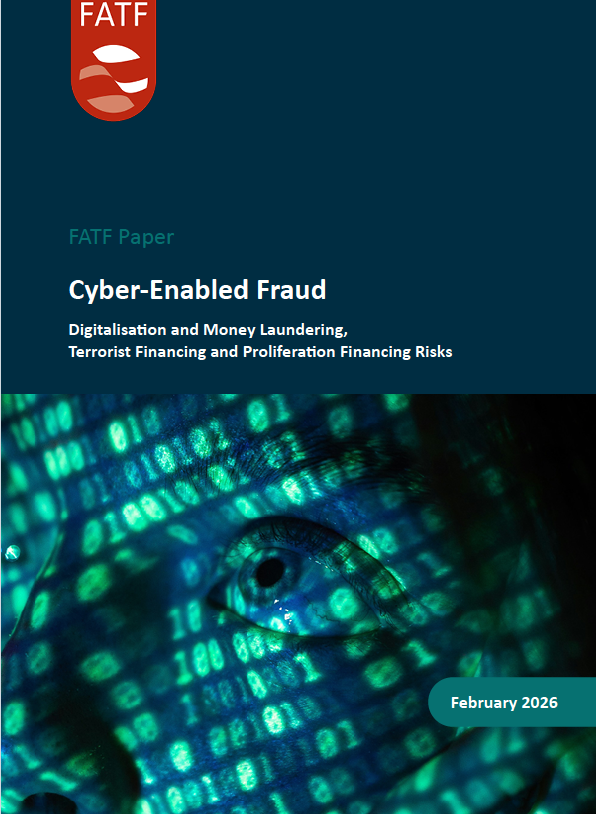
Cyber-enabled fraud is now one of the most widespread and damaging profit-motivated forms of crime, generating large volumes of illicit proceeds through the exploitation of victims around the world.
The paper highlights that in the United Kingdom, fraud now accounts for more than 40% of all crimes, and in Singapore alone, the number of cyber-enabled fraud (scam) cases has increased 61% in two years. 156 jurisdictions, or 90% of the jurisdictions assessed by the FATF, have identified fraud as a major money laundering risk.
In response to this, the new paper, Cyber-Enabled Fraud – Digitalisation and Money Laundering, Terrorist Financing and Proliferation Financing Risks, outlines the latest emerging risks related to technological innovation and fraud.
The paper builds on the FATF’s previous work on the topic, and highlights how countries can use anti-money laundering and counter-terrorist financing tools to prevent money from reaching fraudsters’ hands and recover it when it does.
FATF President, Elisa de Anda Madrazo said: “As fraudsters continue to adapt and accelerate their scams, we need to keep pace to safeguard people’s money and protect victims from the effects of damaging losses. It is vital that countries make use of the expansive FATF toolkit to stop fraudsters preying on vulnerable people around the world.”
With fraudsters using a wide range of methods, including phishing emails, AI-enabled deepfakes, and messaging applications, the paper highlights the importance of stronger implementation of global standards to tackle fraud, including through international cooperation and asset recovery, sharing information quickly with national and international partners, and continuing to adapt to the dynamic cyber-enabled fraud risk environment and intensifying international resolve and action to address the issue.
The paper looks at how the FATF Standards can be leveraged to tackle fraud, including through:
– Payment transparency – increasing traceability of fraud proceeds (i.e. through “confirmation of payee” mechanisms) to limit anonymous funds movements.
– Asset recovery – the revised FATF Standards require payment -suspension or freezing tools, non-convictions-based confiscation and faster international cooperation.
– Regulation of Virtual Assets – Closing gaps and differences in jurisdictions’ implementation of the FATF Standards to reduce misuse of virtual assets for cyber-enabled fraud.
– Unmasking Beneficial Ownership (BO) – Professionalised fraud actors use shell companies to hide criminal proceeds and property. Revised FATF standards on beneficial ownership require countries to take a risk-based and multi-pronged approach to collecting and using BO information for legal persons and arrangements.
– Domestic and international partnerships – national anti-fraud centres share many of the attributes, powers and constituents of national AML co-ordination centres/regimes. Effective inter-agency cooperation across borders can significantly enhance the detection, disruption, and investigation of transnational fraud and scam networks.
– Employing advanced technology – Some financial intelligence units (FIUs) and banks have deployed machine learning models on transaction datasets to detect anomalies associated with fraud and other forms of financial crime. Others have built risk-scoring systems for payments.
As the threat of fraud continues to grow in scale and scope, the FATF has committed to focusing on fraud over the next few years. This includes through continuing to analyse emerging developments, such as the rise of scam centres and the proliferation of these compounds across the world and identifying measures to strengthen countries’ abilities to respond to the fraud epidemic by mobilising the FATF toolkit.
Next month, the FATF will be participating in the Global Fraud Summit in Vienna organised by Interpol and the UN Office on Drugs and Crime (UNODC), where it will emphasise the need for coordinated global action and highlight measures to enhance countries’ operational capabilities to prevent, detect and recover fraud proceeds.
Source: https://www.fatf-gafi.org/en/publications/Methodsandtrends/cyber-enabled-fraud-digitalisation-ml-tf-pf-risks.html
Thanh Tùng – TT81