Decisive action to remove Vietnam from the list of jurisdictions under increased monitoring for anti-money laundering
Unofficial translation from the Vietnamese original.
On the morning of 18 October, chairing a meeting of the Steering Committee for Anti-Money Laundering, Deputy Prime Minister Le Minh Khai said that in June 2023 the Financial Action Task Force (FATF) had placed Vietnam on its list of jurisdictions under increased monitoring. The Government of Vietnam has sent a commitment to the FATF President to implement the action plan set by the FATF, comprising 17 actions to be carried out within two years.
Being placed on the list of jurisdictions under increased monitoring entails disadvantages in international assessments in general, particularly in relation to Vietnam’s economic, trade, investment and international cooperation activities. Recently, the Asia/Pacific Group on Money Laundering (APG) came to Vietnam to work with agencies and the State Bank of Vietnam on steps towards removing Vietnam from the list. Following the delegation’s visit, the State Bank of Vietnam drew up a plan and sent it to the members of the Steering Committee for study and comment.
Many disadvantages
According to the Deputy Prime Minister, as Vietnam has integrated internationally, it must meet the requirements of common international standards. In 2010, Vietnam was placed on the FATF’s list of jurisdictions under increased monitoring. Getting off this list requires many solutions and the implementation of a national action plan. The most difficult and complex part is improving the institutional framework.
Stressing that the Task Force’s requirements are very urgent and the time for implementation very short, and that if Vietnam is not proactive and does not act effectively the situation will become very complicated, the Deputy Prime Minister expressed his dissatisfaction that many members of the Steering Committee were absent from the meeting.
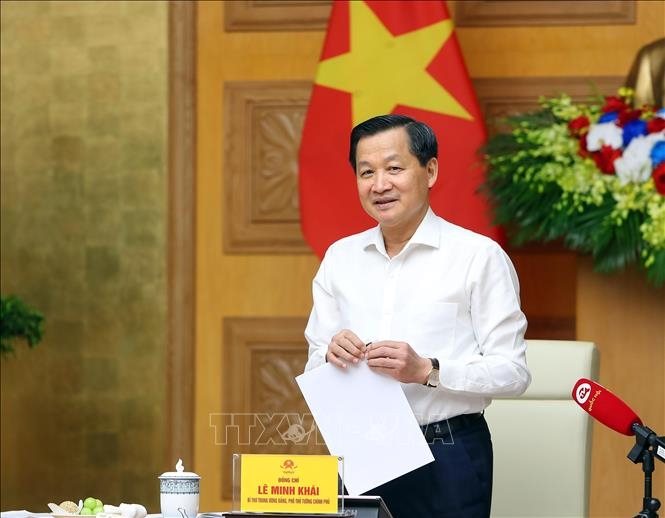
Deputy Prime Minister Le Minh Khai speaks. Photo: VNA
“Their sense of responsibility alone already falls short of requirements,” Deputy Prime Minister Le Minh Khai said, requiring that members of the Steering Committee attend all future meetings. The State Bank of Vietnam – the standing body of the Steering Committee – and ministries and sectors must follow the matter closely, strengthen their responsibility and be determined to get the job done.
Noting that this is a new and difficult task that “no school teaches”, and that the FATF’s official placement of Vietnam on the list of jurisdictions under increased monitoring (the grey list) has a very large impact, Deputy Governor of the State Bank of Vietnam Pham Tien Dung expressed the hope that ministries and sectors would support the State Bank in carrying out this task. This is a common national task, not one for the State Bank alone.
Saying that the banking sector had already seen the negative impact of this, Deputy Governor Pham Tien Dung reported that on 17 October Vietcombank had reported on a number of its policies and relationships with foreign counterparts. In his view, as Vietnam’s economy is highly open and has a large amount of foreign direct investment (FDI), being placed on the grey list has a very large impact.
Deputy Governor Pham Tien Dung listed a range of possible negative impacts, such as higher costs of borrowing and lending for Vietnam and higher costs of investment and trade, leading to reduced FDI inflows as investors become hesitant and cautious. Concessional loans from international organisations (the International Monetary Fund (IMF), the World Bank, the Asian Development Bank, etc.) would no longer be as easy to obtain as before, as additional conditions on compliance with anti-money laundering and counter-terrorist financing rules might be attached. This would lead to a shift towards commercial loans with tougher terms, especially as regards interest rates.
According to IMF estimates, most countries see a decline in capital inflows while on the grey list (an average of 7.6% of GDP, of which FDI falls by 3% of GDP, flows through the banking system by 2% of GDP and flows through the non-bank financial system by 2.4% of GDP).
In addition, it would diminish Vietnam’s political standing and affect its reputation and image in the international arena, and would have a negative impact on its foreign relations, its financial and banking system, and so on.
“Vietnam will be placed on the EU (European Union) list of high-risk countries for money laundering and risks being placed on the blacklist if it cannot demonstrate cooperation in implementing the FATF Recommendations, with particularly serious consequences causing businesses to face higher costs of doing business or even to cease operations in other countries (as in the case of Myanmar in 2022),” Mr Pham Tien Dung warned.
According to Mr Dung, in October 2023 the FATF placed Vietnam on its list of jurisdictions with materially important virtual asset service provider activity. The FATF may therefore require Vietnam to take priority measures to put in place a legal framework on anti-money laundering in relation to virtual assets.
Substantive measures needed
Having attended the meeting with the APG delegation during its working visit to the State Bank of Vietnam and ministries and sectors, Deputy Minister of Foreign Affairs Nguyen Minh Hang shared the State Bank’s view that the volume of work Vietnam has to complete is very large. From the perspective of the Ministry of Foreign Affairs, Ms Nguyen Minh Hang said that the FATF mechanism was established by the G7 countries with international standards on anti-money laundering and counter-terrorist financing. Vietnam must recognise that implementing the commitments to get off the grey list is a highly technical and legal matter that requires substantive measures.
On 18 August, the European Union officially placed Vietnam on its grey list. In addition to the consequences of being on the FATF grey list, the consequences with regard to the EU alone are also considerable, as Vietnam’s economic, trade, financial and banking relations with EU countries are very substantial.
“Countries take this issue very seriously and implement it very rigorously, and only then can they get off the list within two years. Some countries that have not acted seriously have still not got off the list after five years,” Deputy Minister Nguyen Minh Hang noted.
The Deputy Minister said that Vietnam regards the implementation of these commitments and measures as taking place in the context of international integration and risk mitigation, but it must also be recognised that this brings long-term benefits in terms of improving the institutional and policy environment, implementing policies on preventing and combating corruption and crime, improving the investment and business environment, and enhancing the country’s image and prestige.
Deputy Minister Nguyen Minh Hang contributed comments on the action plan, emphasising that advocacy, international cooperation and political and diplomatic outreach to gain further support from other countries on this issue are very necessary as complementary measures. Only by implementing its commitments well will Vietnam have the “capital” for advocacy. The Deputy Minister proposed that the State Bank of Vietnam coordinate with the Ministry of Public Security and the relevant agencies to develop an advocacy plan, and the Ministry of Foreign Affairs will actively coordinate in engaging international partners.
At the meeting, representatives of ministries and sectors discussed and commented on the draft National Action Plan to address money laundering and terrorist financing risks for the 2023-2028 period; the solutions of ministries and sectors for implementing the Prime Minister’s Decision No. 941/QD-TTg promulgating the National Action Plan on anti-money laundering, counter-terrorist financing and counter-proliferation financing for the 2021-2025 period; and the draft operating regulations of the Steering Committee… All participants agreed that, having been placed on the list of jurisdictions under increased monitoring, Vietnam must take action to respond.
Shared responsibility
Concluding the meeting, Deputy Prime Minister Le Minh Khai required the Steering Committee to “do everything possible, decisively, to get Vietnam off the grey list within two years”. Agreeing with the Deputy Minister of Foreign Affairs, the Deputy Prime Minister said that this was not merely a matter of getting off the list; taking these actions would also help create a common legal environment for preventing and combating crime, including corruption, with long-term significance for the common good.
Stressing once again that these are recommendations and requirements of an international organisation which Vietnam, having integrated internationally, must implement, the Deputy Prime Minister required that actions be specific, with clearly described tasks, based on the Constitution, the principles, viewpoints, guidelines and policies of the Party, the law and national cultural traditions, and able to meet practical requirements. Tasks must be assigned feasibly on the basis of the functions and duties of each ministry and sector, on the principle that each task has only one lead agency, with other units coordinating closely.
The State Bank of Vietnam shall take the lead in coordinating with the relevant ministries and sectors to review and finalise the draft plan and Vietnam’s commitments as set by the FATF for early submission to the Prime Minister for promulgation; submit to the Government at an early date for approval the money laundering and terrorist financing risk assessment report and issue the national action plan to address money laundering and terrorist financing risks for the next period; finalise the draft operating regulations of the Steering Committee; and review and evaluate the implementation of Decision 941, accelerating in the coming period any 2023 tasks not yet completed.
Deputy Prime Minister Le Minh Khai drew attention to the tasks of the relevant ministries and sectors. The Ministry of Public Security shall step up investigations into money laundering and the sources of money laundering offences in line with the money laundering risks identified in the report. The Supreme People’s Procuracy and the Supreme People’s Court shall coordinate closely with the Ministry of Public Security to step up judicial activities, prosecutions and trials related to money laundering and terrorist financing offences.
The State Bank of Vietnam and the Ministries of Finance, Justice, Construction, Industry and Trade, and Information and Communications shall step up awareness-raising, direction, inspection and examination of the entities concerned and report on the results of their tasks on anti-money laundering and counter-terrorist financing under the programme of action, so that international organisations can see Vietnam’s efforts in preventing and combating crime, including money laundering, terrorist financing and the proliferation of weapons of mass destruction.
The Deputy Prime Minister required ministries and sectors to share responsibility, strengthen inspection, control and monitoring of the performance of tasks, propose commendation where tasks are performed well, and criticise, take disciplinary action and hold to account those who fail to perform or perform poorly.
Source: People’s Army Newspaper