High-Risk Jurisdictions subject to a Call for Action – October 2023
Unofficial translation from the Vietnamese original.
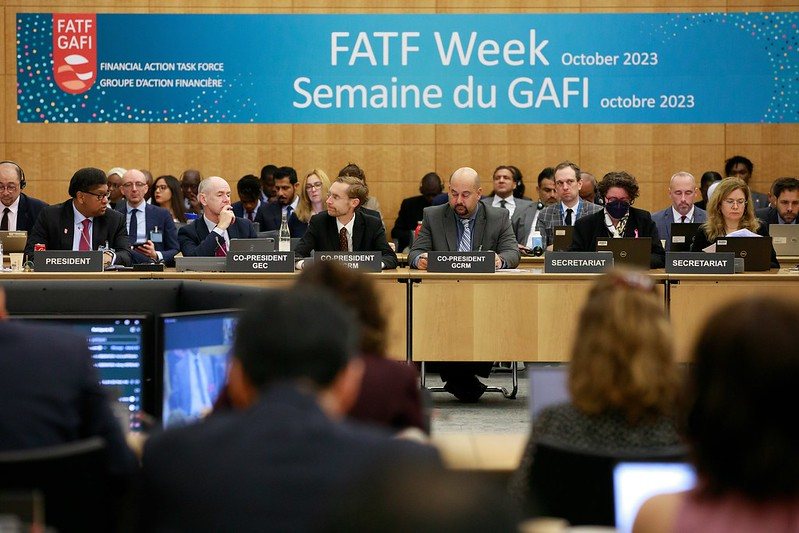
Paris, 27 October 2023 - High-risk jurisdictions have significant strategic deficiencies in their regimes to counter money laundering, terrorist financing, and the financing of proliferation of weapons of mass destruction. For all countries identified as high-risk, the FATF calls on all members and urges all jurisdictions to apply enhanced due diligence, and, in the most serious cases, countries are called upon to apply counter-measures to protect the international financial system from the money laundering, terrorist financing and proliferation financing (ML/TF/PF) risks emanating from the country. This list is often externally referred to as the “black list”. Since February 2020, in light of the COVID-19 pandemic, the FATF has paused the review process for Iran and the Democratic People's Republic of Korea (DPRK), given that they are already subject to the FATF's call for counter-measures. Iran reported in July 2023 that there were no material changes in the status of its action plan. Therefore, the FATF reiterates its call for counter-measures on these high-risk jurisdictions as set out in its statement of 21 February 2020.
Jurisdictions subject to a FATF call on its members and other jurisdictions to apply counter-measures.
Democratic People's Republic of Korea (DPRK)
[Statement unchanged since February 2020]
The FATF remains concerned by the DPRK's failure to address the significant deficiencies in its anti-money laundering and countering the financing of terrorism (AML/CFT) regime and the serious threats they pose to the integrity of the international financial system. The FATF urges the DPRK to immediately and meaningfully address its AML/CFT deficiencies. Further, the FATF has serious concerns with the threat posed by the DPRK's illicit activities related to the proliferation of weapons of mass destruction (WMDs) and its financing.
The FATF reaffirms its 25 February 2011 call on its members and urges all jurisdictions to advise their financial institutions to give special attention to business relationships and transactions with the DPRK, including DPRK companies, financial institutions and those acting on their behalf. In addition to enhanced scrutiny, the FATF further calls on its members and urges all jurisdictions to apply effective counter-measures and targeted financial sanctions in accordance with applicable United Nations Security Council Resolutions, to protect their financial sectors from money laundering, terrorist financing and WMD proliferation financing (ML/TF/PF) risks emanating from the DPRK. Jurisdictions should take the necessary measures to close existing branches, subsidiaries and representative offices of DPRK banks within their territories and terminate correspondent relationships with DPRK banks, where required by relevant UNSC resolutions.
Iran [Statement unchanged since February 2020]
In June 2016, Iran committed to address its strategic deficiencies. Iran's action plan expired in January 2018. In February 2020, the FATF noted that Iran had not completed the action plan.
In October 2019, the FATF called upon its members and urged all jurisdictions to: require increased supervisory examination for branches and subsidiaries of financial institutions based in Iran; introduce enhanced relevant reporting mechanisms or systematic reporting of financial transactions; and require increased external audit requirements for financial groups with respect to any of their branches and subsidiaries located in Iran.
Now, given Iran's failure to enact the Palermo and Terrorist Financing Conventions in line with the FATF Standards, the FATF fully lifts the suspension of counter-measures and calls on its members and urges all jurisdictions to apply effective counter-measures, in line with Recommendation 19.
Iran will remain on the FATF statement on High-Risk Jurisdictions subject to a Call for Action until the full Action Plan has been completed. If Iran ratifies the Palermo and Terrorist Financing Conventions, in line with the FATF standards, the FATF will decide on next steps, including whether to suspend counter-measures. Until Iran implements the measures required to address the deficiencies identified with respect to countering terrorist financing in the Action Plan, the FATF will remain concerned with the terrorist financing risk emanating from Iran and the threat this poses to the international financial system.
Jurisdiction subject to a FATF call on its members and other jurisdictions to apply enhanced due diligence measures proportionate to the risks arising from the jurisdiction.
Myanmar
In February 2020, Myanmar committed to address its strategic deficiencies. Myanmar's action plan expired in September 2021.
In June 2022, the FATF strongly urged Myanmar to swiftly complete its action plan by October 2022, failing which the FATF would call on its members and urge all jurisdictions to apply enhanced due diligence to business relations and transactions with Myanmar. Given the continued lack of progress and the majority of its action items still outstanding a year after the expiry of the action plan deadline, the FATF has decided that further action in line with its procedures was necessary, and the FATF calls on its members and urges all other jurisdictions to apply enhanced due diligence measures proportionate to the risk arising from Myanmar. When applying enhanced due diligence measures, countries should ensure that flows of funds for humanitarian assistance, legitimate non-profit organisation activity and remittances are not disrupted.
Myanmar should continue to work on implementing its action plan to address these deficiencies, including by: (1) demonstrating an improved understanding of money laundering risks in key areas; (2) demonstrating that onsite/offsite inspections are risk-based, and that hundi operators are registered and supervised; (3) demonstrating enhanced use of financial intelligence in law enforcement agency (LEA) investigations, and increasing operational analysis and disseminations by the financial intelligence unit (FIU); (4) ensuring that money laundering is investigated/prosecuted in line with risks; (5) demonstrating the investigation of transnational money laundering cases with international cooperation; (6) demonstrating an increase in the freezing/seizing and confiscation of criminal proceeds, instrumentalities and/or property of equivalent value; and (7) managing seized assets to preserve the value of seized goods until confiscation.
The FATF urges Myanmar to work to fully address its AML/CFT deficiencies, including by demonstrating that its monitoring of money or value transfer services (MVTS) is based on a clear and well-documented understanding of ML/TF risks, in order to mitigate excessive monitoring of legitimate legal financial flows.
Myanmar will remain on the list of countries subject to a call for action until its full action plan is completed.
[1] In June 2016, the FATF welcomed Iran's high-level political commitment to address its strategic AML/CFT deficiencies, and its decision to seek technical assistance in the implementation of the Action Plan. Since 2016, Iran has established a cash declaration regime, enacted amendments to its Counter-Terrorist Financing Act and its Anti-Money Laundering Act, and adopted an AML by-law.
In February 2020, the FATF noted that items remained outstanding and that Iran should fully address: (1) adequately criminalising terrorist financing, including by removing the exemption for designated groups “attempting to end foreign occupation, colonialism and racism”; (2) identifying and freezing terrorist assets in line with the relevant United Nations Security Council resolutions; (3) ensuring an adequate and enforceable customer due diligence regime; (4) demonstrating how authorities are identifying and sanctioning unlicensed money/value transfer service providers; (5) ratifying and implementing the Palermo and Terrorist Financing Conventions and clarifying the capability to provide mutual legal assistance; and (6) ensuring that financial institutions verify that wire transfers contain complete originator and beneficiary information.
[2] Countries may apply appropriate counter-measures when called upon to do so by the FATF. Countries may also apply counter-measures independently of any call by the FATF to do so. Such counter-measures should be effective and proportionate to the risks.
The Interpretive Note to Recommendation 19 specifies examples of the counter-measures that could be undertaken by countries.
(According to fatf-gafi.org, translated by Thu Hà – TT81)