Some aspects of the FATF grey list
Unofficial translation from the Vietnamese original.
The year 2025 marks the 24th anniversary of the Financial Action Task Force (FATF) statement on the list of jurisdictions under increased monitoring (also known as the list of countries or jurisdictions with serious strategic deficiencies in anti-money laundering (AML), countering the financing of terrorism (CFT) and countering proliferation financing (CPF)).
While the FATF maintains that being named in the statement is not a sanction, being placed on what is more commonly known as the “grey list” entails many adverse risks for the countries concerned.
Jonah Anderson, a partner at the law firm White & Case in the United Kingdom, said: “Much of the impact of the FATF grey list is on a country's international reputation. Particularly if you are a developed economy, you want to avoid reputational damage, and you are therefore likely to devote significant resources to getting off the list as soon as possible.”
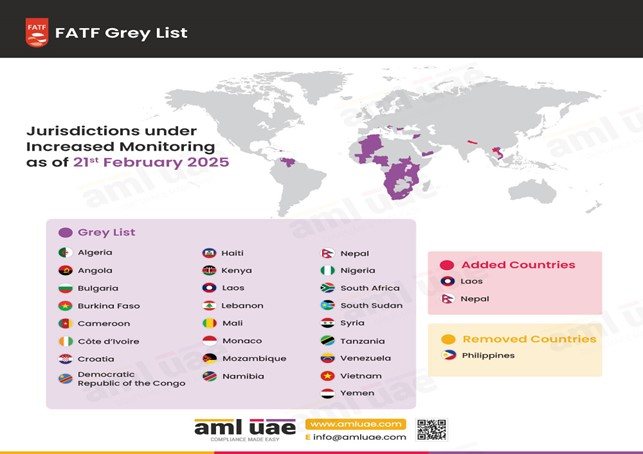
The FATF, whose presidency rotates among member countries every two years (Singapore currently holds the presidency until June), met in Paris on 19-21 February 2025 for the first of its three annual plenary meetings. The 23 countries currently on the grey list will be watching closely to see whether they are removed from the list, while other countries are anxiously waiting to see whether they will be considered for addition to it.[1]
Iran, North Korea and Myanmar – high-risk jurisdictions subject to a call for action – are unlikely to leave the “blacklist” in the next few meetings.
As the lists approach their 25th anniversary, there is much debate about their significance at the macroeconomic level and particularly for banks, as lenders' compliance departments become increasingly stringent and questions continue to be raised about the overall fairness of the FATF evaluation process.
The development of the FATF
The FATF was established by the G7 in 1989 with the aim of “examining and developing measures to combat money laundering”. In 2001, its mandate was expanded to include terrorist financing, following the 11 September attacks in the United States. With its standards updated over the years, the FATF Standards now cover areas including developments in money laundering techniques, the financing of the proliferation of weapons of mass destruction, asset recovery, the identification of beneficial ownership and activities involving virtual assets.
First proposed in 2000, the grey list comprises countries identified as having strategic deficiencies in anti-money laundering and countering the financing of terrorism, and also requires these countries to make a political commitment to address those deficiencies. The blacklist comprises countries considered not to be actively cooperating with the FATF on those deficiencies. Both lists are updated once every three years at FATF plenary meetings.
Of the 23 jurisdictions on the grey list, several, including Gibraltar, the UAE, the Philippines and Uganda, expressed confidence and were removed from the list after last week's meeting, each having introduced a series of measures to strengthen its AML/CFT framework.
Assessing the impact
Experts consider that being placed on the grey list has clear consequences for a country's economy and financial system, noting that the move can restrict cross-border transactions, making it difficult for a country to access credit and limiting foreign investment.
A 2021 study by the IMF analysed the significant impact of the grey list on capital inflows, finding an average decline of 7.6% of GDP when a country is placed on the grey list.
The study also showed that foreign direct investment inflows fell by an average of 3%, portfolio investment inflows by an average of 2.9% and other investment inflows by an average of 3.6% of GDP.
Part of the additional economic damage arises from the requirement for enhanced due diligence on counterparties based in listed countries, resulting in higher costs and additional time commitments from the managers concerned.
While World Bank data show that around two thirds of the countries currently on the grey list saw a decline in net FDI as a percentage of GDP in 2022, in many cases this decline was part of a trend that began years before they were placed on the list.
Given the diversity of the economies on the list, common signs of economic impact are almost impossible to pinpoint. For example, the UAE, placed on the grey list in March 2022, is the second-largest economy in the Middle East and has little in common with the other Middle Eastern countries on the grey list, Syria and Yemen.
A government adviser told The Banker: “In the almost two years since the UAE was placed on the grey list, its economy has grown strongly on the back of higher energy prices, while it has continued to attract large amounts of foreign direct investment. It is hard to look at the figures and say that they have been held back by being on the grey list.”
Assessments are not yet fair
FATF grey list decisions have attracted considerable criticism over the years from the countries affected. While welcoming Panama's removal from the list last year, President Laurentino Cortizo told the Financial Times that his country had been treated unfairly “because this country is home to only 0.27% of the world's offshore companies. You have to ask where the other 99% of offshore companies are”, he said, pointing to the tax-haven status of the US state of Delaware. “It is important that they also address their own tax havens,” he said.
FIBA's Schwartz noted that, as part of the FATF mutual evaluation process, the body sends assessment teams from different regions of the world. These teams may not be familiar with the region being assessed, and the body should consider assessing legal, financial and banking systems in the light of the specific characteristics of the country concerned. Aspects of the assessment are sometimes subjective observations or stem from an incomplete understanding of the mechanisms for developing legislation, standards and services in the various sectors... Yet the results of these assessments are a key factor in determining whether a country has deficiencies in its AML/CFT/CPF regime.
A global jigsaw puzzle
According to Mr Anderson, although awareness of each country's conditions is very important, the FATF's global perspective remains a necessary and indispensable part of its mandate. He said: “The FATF's goal of consistency is a sound concept, in which the fight against financial crime is like an international jigsaw puzzle, where the pieces must fit together to be effective. There will always be questions about implementation, but there has to be a truly global approach with a degree of standardisation. Although being placed on the grey list may cause disagreement, most countries recognise the importance of upgrading the legal and regulatory frameworks needed to get off the list.
According to Kumar, over the past 35 years the body's initiatives, including the grey list and the blacklist, have brought marked improvements in the international fight against financial crime: “Eighty-seven per cent of FATF members have achieved a high level of compliance with the body's technical standards. Among countries that are not members but are part of a FATF-style regional body, around 73 per cent have achieved compliance, so we have seen tremendous progress over the years.”
Conclusion: Overall, countries placed on the grey list also have reason for optimism, since of the 98 countries placed on the list by the FATF up to October 2023, 76 have been removed.
Thanh Tung – Centre 81
[1] Since June 2023, after being placed on the grey list, Vietnam has made a high-level political commitment to work with the FATF and the Asia/Pacific Group on Money Laundering (APG) to strengthen the effectiveness of its AML/CFT/CPF regime. To date, Vietnam has made some progress. The FATF encourages Vietnam to strengthen internal coordination to demonstrate progress in implementing its action plan to address its strategic deficiencies.