Preventing and countering the risk of WMD proliferation
Unofficial translation from the Vietnamese original.
Major General HA VAN CU, Commander of the Chemical Corps, Standing Deputy Head of the National Focal Point for countering the proliferation of weapons of mass destruction.
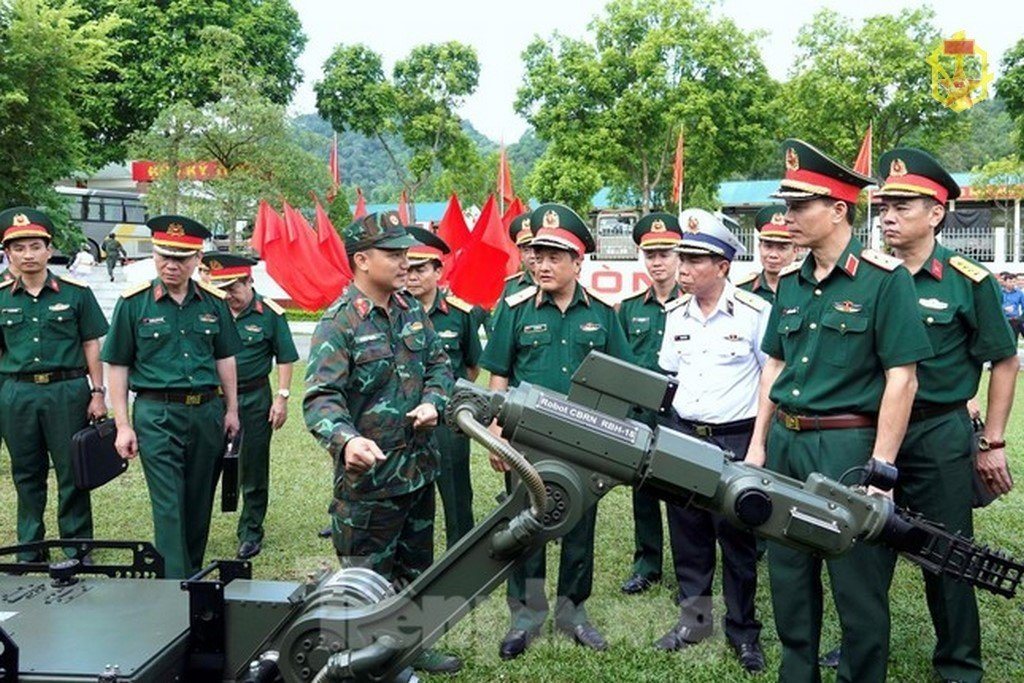
Leaders of the General Staff of the Vietnam People’s Army inspect radiological and chemical reconnaissance equipment developed by the Chemical Corps
Future wars do not rule out the possibility of an adversary using weapons of mass destruction (WMD). In recent years, in the face of the growing risks of WMD proliferation and terrorism, Vietnam has ratified all international treaties on disarmament and the non-proliferation of WMD. To be ready to defeat any war of aggression, including one in which the enemy uses WMD, and at the same time to proactively and effectively prevent and respond to chemical, biological, radiological and nuclear incidents, disasters and terrorist threats, the foremost tasks at present are to complete the network, anticipate risks and step up awareness-raising.
Weapons of mass destruction, also known as weapons of large-scale destruction, are weapons designed and manufactured with the capacity to kill and destroy over a wide area, causing heavy to very heavy losses of personnel, technical equipment, infrastructure and the ecological environment, and causing psychological panic among people. They comprise nuclear weapons, radiological weapons, chemical weapons, biological weapons and other weapons with characteristics and effects similar to those of weapons of mass destruction.
In the history of world warfare, WMD have been used on different scales and to different degrees, with extremely catastrophic consequences. On 22 April 1915, during the First World War, the German army used about 168 tonnes of chlorine gas, causing the deaths of at least 5,000 people. During the Second World War, chemical weapons continued to be used, for example by the Italian army in its war with Ethiopia; blister agents were used in the Iran-Iraq war; and chemical weapons have continued to be used in the conflict in Syria.
Nuclear weapons have been used twice. In the final stage of the Second World War, the United States dropped the atomic bomb “Little Boy” on the city of Hiroshima and “Fat Man” on the city of Nagasaki in Japan. The two explosions in Japan claimed the lives of more than 200,000 people.
Biological weapons have also been researched and used in the world. In the past, the British army used smallpox against Native Americans during the siege of Fort Pitt; the Japanese army researched and used cholera and typhus bacteria in China; and the Allied countries in the Second World War built facilities for the mass production of anthrax spores and Brucella bacteria.
In particular, history has recorded the use of weapons of mass destruction for terrorist purposes. In March 1995, members of the Aum Shinrikyo cult used the nerve agent sarin in a terrorist attack on the Tokyo subway, killing 13 people and seriously injuring 50 others, while some 5,500 victims required medical assistance; and the anthrax attacks in the United States in 2001 caused the deaths of five people and hundreds of millions of dollars in clean-up and decontamination costs.
Recognising the devastation caused by WMD, the countries of the world met and agreed to establish treaties and conventions to prevent it: in 1968, the Treaty on the Non-Proliferation of Nuclear Weapons (NPT) was concluded; in 1972, the Convention on the Prohibition of the Development, Production and Stockpiling of Biological Weapons (BWC); in 1993, the Convention on the Prohibition of the Development, Production, Stockpiling and Use of Chemical Weapons (CWC); and in 1996, the Comprehensive Nuclear-Test-Ban Treaty (CTBT). Vietnam has always shown itself to be an active member in participating in these treaties and conventions.
Given the political and security instability in countries in the region and around the world, especially separatism, terrorism and ethnic and religious conflicts, the risk of WMD being used to achieve such ends remains ever present. The breakdown of nuclear arms control mechanisms and the recent policies of nuclear-weapon States to modernise their nuclear arsenals have caused considerable concern, threatening humanity’s peaceful life and increasing the risks of conflict and war.
In view of these important issues, at the end of 2019 the Government issued Decree No. 81/2019/ND-CP on countering the proliferation of weapons of mass destruction (Decree No. 81). The Ministry of National Defence was designated by the Prime Minister as Vietnam’s National Focal Point for countering the proliferation of weapons of mass destruction, and the Chemical Corps was assigned as the Standing Office of the National Focal Point; at the same time, international cooperation activities, training courses, workshops, exercises and drills have been organised… to progressively put Decree No. 81 into practice in a manner suited to the conditions and characteristics of Vietnam.
To date, the Standing Office of Vietnam’s National Focal Point for countering the proliferation of weapons of mass destruction (Standing Office 81) has been operating actively and has achieved notable results, progressively stepping up awareness-raising on WMD among the people, while actively completing the network and anticipating and preparing plans to defuse risks and to prevent and counter terrorism involving weapons of mass destruction.
Standing Office 81 has advised and assisted the Ministry of National Defence and the Government, and guided ministries, sectors and localities in carrying out their tasks in accordance with regulations and effectively; issued documents giving concrete effect to the regulations on countering the proliferation of WMD as a basis for handling situations related to the proliferation of WMD and proliferation financing; and established and operated the Information Page on countering the proliferation of WMD on the Ministry of National Defence’s Web Portal. The Web Portal of Standing Office 81 and its hotline have been connected with the Web Portals of the Ministry of Public Security, the State Bank of Vietnam and other units to update information on countering the proliferation of WMD and proliferation financing. Competent authorities and relevant forces have organised training, training courses and exercises on readiness to respond to WMD proliferation situations for the forces tasked with countering the proliferation of WMD, thereby raising the awareness and the capacity of specialised forces, state agencies and the public to prevent and respond to WMD proliferation situations.
Ministries, ministerial-level agencies and provinces and centrally governed cities have also developed plans to implement Decree No. 81 and have exercised their state management responsibilities as provided for in Decree No. 81; they have organised information, communication and education activities to raise the awareness of cadres, civil servants, public employees and the entire population of countering the proliferation of WMD; strengthened state management of security and public order; controlled transport, publishing, press, postal and telecommunications activities, food safety, pharmaceuticals, biological and chemical agents, radioactive and nuclear materials, and dispersal technologies and means of delivery; managed the financial sector and the activities of designated non-financial businesses and professions and relevant agencies, organisations and individuals; and tightly controlled border and maritime areas in order to detect, prevent and promptly deal with acts of proliferation of WMD and proliferation financing.
Countering the proliferation of WMD is a new, complex and sensitive task involving many ministries, sectors and localities as well as countries, territories and international organisations, so the awareness and implementation of some ministries, sectors and localities still face certain difficulties and obstacles. For this work to be conducted in a coordinated and effective manner, contributing to preventing all risks and fully meeting international requirements, it is necessary to complete the network at an early date and be ready to anticipate and defuse risks by strengthening the leadership of the Party and the administration of the State in organising and implementing the task of countering the proliferation of WMD, and by researching and completing a coherent and rigorous system of legal normative documents and materials related to countering WMD. At the same time, the functions and tasks of each level of government, agency and unit must be clarified, so as to form a network for unified management, the timely detection of proliferation and proliferation financing activities serving terrorist purposes, and the prevention of the risk of international WMD proliferation.
Along with this, attention must be paid to improving the effectiveness of education, awareness-raising, knowledge dissemination, training and exercises on countering the proliferation of WMD; emphasis should be placed on disseminating knowledge through science education programmes in the mass media and on harnessing the communication power of press agencies both inside and outside the Army; and posters, leaflets, handbooks and websites should be compiled, published and widely distributed among the people so that knowledge about countering proliferation reaches every citizen. Specialised forces need to be trained and to conduct exercises regularly and under realistic conditions, so as to avoid being caught off guard or taken by surprise when a situation occurs. Emphasis should be placed on developing human resources and investing in modern specialised equipment capable of performing tasks in the context of international cooperation on countering the proliferation of WMD, while promoting internal strength and working closely with international organisations in countering the proliferation of WMD.
Major General HA VAN CU - Commander of the Chemical Corps